

To select the right frameless glass door hardware, begin with the door dimensions, glass thickness, weight, opening configuration and expected traffic. Then confirm the load capacity, mounting method, glass preparation, material, finish and compatibility of every component before the glass is manufactured.
This system-based approach helps prevent common problems such as door sagging, uncontrolled closing, misaligned locks, glass cutout conflicts and premature hardware wear.
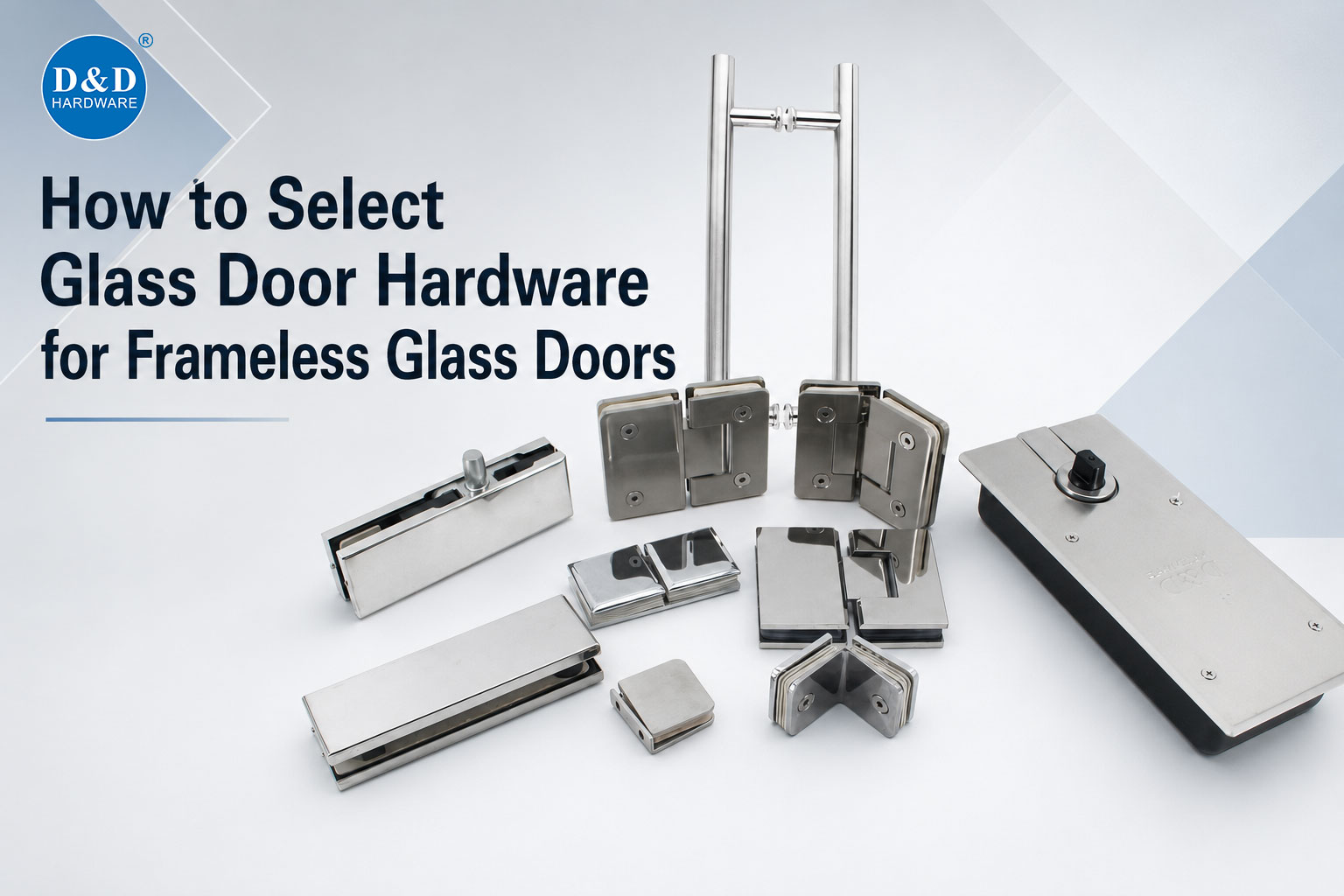
What Hardware Is Required for a Frameless Glass Door?
The exact hardware schedule depends on whether the door is hinged, pivoted, sliding, single-action or double-action. A typical commercial frameless glass door may require:
- A floor spring or glass door hinge
- Top and bottom patch fittings
- A top pivot or transom patch
- A glass door lock
- Pull handles or lever handles
- Strike fittings
- Glass clamps or connectors
- Door stops
- Seals and protective accessories
These products cannot be selected independently. The floor spring must support the door weight, the patch fittings must match the pivot system, and the lock must align with the correct strike. All glass cutouts and drilled holes must also correspond to the approved hardware drawings.
Start with the Door Specification
Before comparing hardware models, prepare the basic door information. This is the foundation of a reliable hardware selection.
Door Width, Height and Weight
The dimensions and calculated weight of the glass panel determine the required load capacity of floor springs, hinges and pivot fittings. Wider doors also create greater leverage on the pivot system, so door weight alone is not always sufficient for selection.
The supplier should evaluate:
- Overall door width and height
- Glass thickness
- Approximate door weight
- Distance from the pivot point to the door edge
- Weight added by locks, handles and decorative components
- Expected opening frequency
Never select a floor spring solely because its maximum stated capacity is slightly higher than the door weight. Commercial doors should have a suitable performance margin for repeated operation and long-term adjustment.
Glass Type and Thickness
Frameless doors are commonly produced from tempered safety glass. Depending on the project, laminated or other safety-glazing constructions may also be specified.
Glass thickness must match the clamping range of the selected hardware. If a patch fitting or lock is intended for a different thickness, the clamping pressure may be incorrect. This can cause movement, poor alignment or concentrated stress on the glass.
The glass type must be confirmed before drilling or cutting. Tempered glass generally cannot be modified after tempering, so every hole and cutout must be finalized before production.
Opening Configuration
Identify how the door needs to operate:
| Door configuration | Typical hardware solution |
| Single-action swing door | Glass hinges or floor spring with restricted opening |
| Double-action swing door | Floor spring with top and bottom patch fittings |
| Pivot glass door | Floor spring or pivot hinge system |
| Sliding glass door | Sliding track, rollers, guides, handles and stops |
| Double glass doors | Coordinated floor springs, locks, strikes and door stops |
| Glass-to-wall installation | Wall-mounted hinges, patch fittings or connectors |
| Glass-to-glass installation | Glass-to-glass hinges, clamps or patch fittings |
The selected system must suit both the desired movement and the surrounding structure.
How to Select a Floor Spring
A floor spring is a concealed door-closing mechanism installed below the floor. It is widely used for commercial frameless glass doors because it supports the door while providing controlled opening and closing.
When selecting a glass door floor spring, consider the following factors.
Load Capacity
The floor spring must be suitable for the actual door width and weight. A model operating too close to its limit may wear quickly or struggle to control the door. An oversized unit can also make the door unnecessarily difficult to open if its spring force is not adjustable.
For heavy or oversized doors, select a heavy-duty floor spring specifically designed for higher loads.
Single-Action or Double-Action Operation
Double-action floor springs allow the door to swing in both directions and return toward the closed position. They are common in office entrances, retail spaces and internal commercial partitions.
Single-action configurations restrict the door to one opening direction. They may be more appropriate where traffic flow, wall position or project requirements do not permit two-way operation.
Hold-Open Function
A hold-open floor spring keeps the door open at a predetermined angle. This can be useful for general entrances, showrooms and spaces where doors remain open during business hours.
However, hold-open hardware may not be appropriate for every fire, smoke-control or code-regulated opening. Project requirements must be reviewed before selecting this function.
Closing Adjustment
Commercial floor springs should provide controlled adjustment so installers can balance door movement after installation. Depending on the model, adjustment may include closing speed, latching speed or backcheck-related control.
A properly adjusted door should close smoothly without slamming, stopping short of the frame or placing unnecessary stress on the glass fittings.
Floor and Site Conditions
Floor springs require accurate floor preparation and a stable installation base. Confirm the available installation depth, finished-floor level, drainage conditions and access for future adjustment.
For entrances exposed to rain, cleaning water or high humidity, corrosion protection and floor-box sealing become especially important.
How to Select Glass Patch Fittings
Patch fittings connect the glass panel to the floor spring, pivot, transom or adjacent glass. They are essential structural components in many frameless glass door systems.
Common configurations include:
- Bottom patch fittings
- Top patch fittings
- Corner patch fittings
- Over-panel patch fittings
- Glass-to-glass patch fittings
- Lock patch fittings
- Hydraulic patch fittings
The selected patch fittings must belong to a compatible system. A bottom patch fitting, floor spring spindle and top pivot should not be combined only because they appear dimensionally similar.
Check the following before ordering:
- Suitable glass thickness
- Maximum recommended door size and weight
- Spindle or pivot compatibility
- Glass cutout dimensions
- Cover material and finish
- Installation orientation
- Gasket and fixing requirements
- Compatibility with locks and adjacent panels
Approved technical drawings should be sent to the glass processor before cutting begins.
When Should Glass Door Hinges Be Used?
Glass door hinges are often used for lighter swing doors, shower enclosures, office partitions and applications where a floor spring is unnecessary or difficult to install.
The main mounting types include:
- Glass-to-wall hinges
- Glass-to-glass hinges
- Pivot hinges
- Self-closing glass hinges
- Hydraulic glass hinges
When selecting hinges, confirm the maximum door dimensions and weight supported by the complete hinge set. The number of hinges, their spacing and the condition of the supporting wall or frame also affect performance.
For busy commercial entrances, a floor spring and patch-fitting system may provide better support than small point-mounted hinges. For lighter internal doors, suitable glass hinges can offer a cleaner and simpler installation.
Choose Locks According to the Required Function
A frameless glass door lock should provide the required security without creating unnecessary stress around the glass cutout.
Common options include:
- Center glass door locks
- Bottom patch locks
- Corner patch locks
- Glass-to-glass locks
- Glass-to-wall locks
- Lever-operated glass door locks
- Pull-handle locks
- Deadbolt locks
Before selecting a lock, determine whether the door is single or double, the locking position and the type of surrounding structure. A lock fitted to a glass-to-glass double-door system requires a different strike arrangement from one locking into a wall, floor or framed sidelight.
Also verify:
- Glass thickness
- Door handing, where applicable
- Cylinder type
- Locking direction
- Strike configuration
- Required glass preparation
- Access requirements from each side
- Compatibility with the handle arrangement
For double doors, one leaf may also require a coordinated floor bolt or patch-lock solution to create a secure strike point for the active leaf.
Select Pull Handles for Both Function and Appearance
Pull handles are visually prominent, but appearance should not be the only selection factor. The handle must also suit the door size, traffic level and installation environment.
For most commercial interiors, stainless steel provides a durable and versatile solution. D&D offers SS304 pull handles as a standard option, while SS316 can be specified for coastal, marine or other corrosive environments.
Consider:
- Handle length and projection
- Grip diameter
- Fixing-center distance
- Single-sided or back-to-back installation
- Glass thickness
- Clearance from the door edge
- Finish coordination
- Accessibility and ease of grip
- Resistance to corrosion and frequent cleaning
Longer pull handles can improve visibility and usability on large entrance doors, while compact handles may be more suitable for smaller internal doors.
Match the Material to the Environment
Glass door hardware is frequently exposed to hand contact, cleaning chemicals, humidity and outdoor air. Material selection directly affects appearance and service life.
| Environment | Recommended consideration |
| Dry commercial interior | SS304 or suitable architectural-grade finishes |
| Hotel or office entrance | Durable stainless steel with coordinated finishes |
| Coastal or marine location | SS316 or enhanced corrosion-resistant material |
| Swimming pool or high-humidity area | High corrosion resistance and regular maintenance |
| Exterior entrance | Weather exposure, drainage and protective sealing |
| High-traffic public building | Heavy-duty construction and easy-to-clean surfaces |
A decorative finish does not replace a suitable base material. The hardware specification should account for the actual environment rather than color alone.
Coordinate the Finish Across the Door System
Frameless glass makes every fitting visible. Even small differences in color or surface texture can affect the appearance of the completed entrance.
Popular finishes include:
- Satin stainless steel
- Polished stainless steel
- Matte black
- PVD finishes
- Custom architectural colors
Where possible, source the patch fittings, handles, locks, hinges and related accessories from the same coordinated product range. Finish samples should be approved for projects where visual consistency is especially important.
Plan Glass Cutouts Before Production
Incorrect glass preparation is one of the most expensive mistakes in frameless door projects. Once tempered glass has been manufactured, holes and cutouts usually cannot be changed.
The final glass drawing should identify:
- Door dimensions
- Glass thickness
- All drilled-hole locations
- Patch-fitting cutouts
- Lock cutouts
- Handle fixing centers
- Edge distances
- Hinge positions
- Top and bottom clearances
Do not prepare glass from a generic drawing downloaded for a similar-looking product. Use the drawing for the exact hardware model being supplied.
A final coordination check between the hardware supplier, glass processor and installer can prevent replacement glass, installation delays and site modifications.
Consider Traffic Level and Maintenance
A meeting-room door used occasionally does not have the same performance requirements as a shopping-center entrance operating throughout the day.
For high-traffic frameless doors, prioritize:
- Heavy-duty floor springs or hinges
- Stable pivot and patch-fitting connections
- Adjustable closing control
- Durable handle fixings
- Replaceable wearing components
- Accessible adjustment points
- Corrosion-resistant materials
- Availability of technical documentation and spare parts
Hardware should also be inspected periodically. Loose fixings, changing door clearances, oil leakage, unusual noise and inconsistent closing are early signs that adjustment or maintenance may be required.
Common Selection Mistakes to Avoid
Selecting Components Separately
A collection of individually suitable products does not automatically create a compatible door system. Floor springs, pivots, patch fittings, locks and strikes must work together.
Ignoring Door Width
Two doors with the same weight can place different loads on the pivot system if their widths are different. Both dimensions must be considered.
Preparing the Glass Too Early
Glass should not enter production until the final hardware models and technical drawings have been approved.
Choosing Finish Before Material
The visible finish may look identical, while the underlying material and corrosion resistance are different. Start with the environment and performance requirements.
Using Residential Hardware on Commercial Doors
Light-duty fittings may not withstand the traffic or door dimensions found in offices, hotels, retail spaces and public buildings.
Leaving Installation Conditions Unchecked
Floor depth, wall reinforcement, ceiling structure, panel alignment and surrounding glass dimensions can all influence the final hardware configuration.
A Practical Frameless Glass Door Hardware Checklist
Before confirming an order, provide the supplier with:
- Door width and height
- Glass thickness and type
- Estimated door weight
- Single- or double-door configuration
- Single- or double-action operation
- Required opening angle
- Traffic level
- Indoor or outdoor location
- Locking and access requirements
- Preferred handle style
- Required material and finish
- Glass-to-wall or glass-to-glass installation
- Available floor depth
- Project drawings and installation details
The supplier should then confirm the proposed system, hardware load capacity, component compatibility and glass preparation drawings.
Why Source Frameless Glass Door Hardware from D&D?
D&D supplies coordinated glass door hardware for commercial and architectural projects. The product range includes floor springs, patch fittings, glass hinges, pivots, locks, pull handles, clamps, connectors and related glass door accessories.
Working with one experienced supplier makes it easier to coordinate:
- Floor spring and patch-fitting compatibility
- Glass thickness and cutout requirements
- Lock and strike configurations
- Material and finish consistency
- Hardware for different door sizes and applications
- Product drawings and installation information
- OEM and private-label requirements
- Packaging for complete project sets
Rather than selecting hardware only from a product photograph, D&D can review the door configuration and help buyers identify a suitable combination based on the project information provided.
Frequently Asked Questions
What is the best hardware system for a frameless glass entrance door?
For many commercial entrance doors, a floor spring combined with top and bottom patch fittings provides a clean appearance and controlled door movement. The exact system should be selected according to the door dimensions, weight, traffic level and opening direction.
How thick should a frameless glass door be?
The correct glass thickness depends on the door size, glass construction, hardware system and applicable project requirements. Always confirm that the selected hinges, patch fittings, locks and handles support the specified thickness.
Can a floor spring be used with a double-action glass door?
Yes. Double-action operation is one of the most common applications for floor springs. The floor spring, bottom patch, top patch and pivot must be selected as a compatible system.
Can holes be added after the glass is tempered?
Tempered glass generally should not be drilled or cut after tempering. All hardware holes and cutouts must be confirmed before glass production.
Is SS304 suitable for glass door hardware?
SS304 is suitable for many interior commercial applications. SS316 should be considered for coastal, marine, poolside or other corrosive environments.
Should all glass door hardware come from one supplier?
It is not always mandatory, but sourcing a coordinated system from one supplier can reduce compatibility risks, simplify finish matching and make technical support more efficient.
Conclusion
Selecting frameless glass door hardware is a technical coordination process, not simply a matter of choosing products that look attractive. Door size, glass weight, opening configuration, traffic, locking function, environment and glass preparation must all be reviewed together.
The most reliable approach is to finalize a complete hardware system before manufacturing the glass. Compatible floor springs, patch fittings, hinges, locks and handles will improve door movement, security, appearance and long-term performance.
For a project-specific recommendation, send D&D the door dimensions, glass thickness, opening type, expected traffic level and drawings. Our team can help identify a coordinated frameless glass door hardware solution and provide the technical information required for accurate glass preparation and installation.
David Jian:
Tel / WhatsApp / Wechat:+86-139 2903 7292