

Choosing the right glass door hinge plays an essential role in the performance, safety, and usability of modern glass door systems. Among all available options, 90 degree glass hinge and 180 degree glass hinge are the most widely used in frameless glass doors, shower enclosures, office partitions, retail storefronts, and commercial interiors.
Although these two hinge types appear similar, their opening angles directly influence door movement, space efficiency, durability, and user experience. Selecting an unsuitable hinge may result in restricted access, door collision, excessive stress on hardware, or reduced service life. Understanding the differences between these two hinge types is therefore critical before making a final decision.
Understanding Glass Door Hinges and Opening Angles
Glass door hinges are specifically engineered to support and control glass doors while maintaining a clean and modern appearance. Compared with traditional hinges, they must handle glass weight, thickness, and stress concentration more precisely.
The opening angle defines how far a door can swing from the closed position. This factor affects daily usability, safety, and how efficiently the surrounding space is utilized. In most architectural projects, 90 degree and 180 degree hinges are preferred due to their balance between functionality and structural reliability.
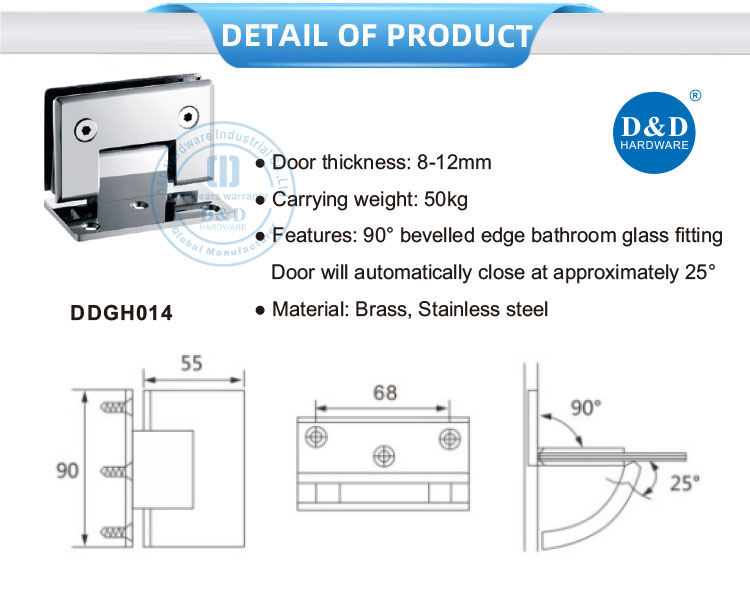
What Is a 90 Degree Glass Door Hinge?
A 90 degree glass door hinge allows the door to open to a maximum angle of 90 degrees, forming a right angle between the door and the wall or fixed glass panel. This controlled opening makes it ideal for spaces where door movement must be limited.
Because the swing range is restricted, these hinges help prevent doors from hitting nearby walls, fixtures, or furniture while maintaining stable operation.
Common features of 90 degree glass door hinges include:
-
Controlled opening for improved safety
-
Suitable for wall-to-glass and glass-to-glass installations
-
Ideal for medium-weight glass doors
They are frequently used in bathrooms, hotel rooms, residential interiors, and small office spaces.
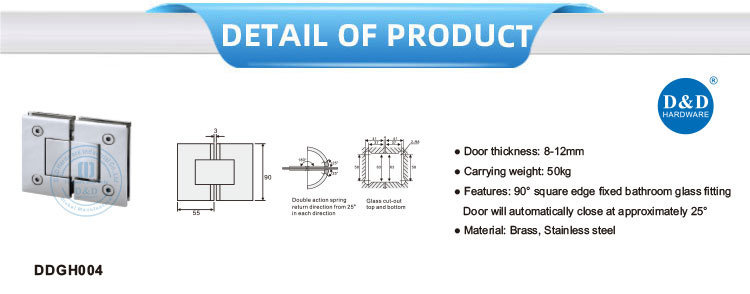
What Is a 180 Degree Glass Door Hinge?
A 180 degree glass door hinge allows the door to open fully, laying almost flat against the wall or adjacent glass panel. This creates a wide, unobstructed opening that improves accessibility and traffic flow.
These hinges are designed for environments where openness and flexibility are important, particularly in commercial or public spaces.
Typical characteristics include:
-
Full swing opening for easy access
-
Strong internal structure to support heavier doors
-
Commonly used in glass-to-glass configurations
They are widely applied in retail stores, office entrances, conference rooms, and commercial buildings.
Structural and Performance Differences
The difference in opening angle leads to different load behavior. A 90 degree hinge keeps the door’s weight closer to the pivot point, reducing torque stress and helping extend hinge lifespan.
A 180 degree hinge, however, experiences greater leverage when fully opened. For this reason, it is usually manufactured with thicker materials and reinforced pivot systems to ensure long-term durability. Door weight, glass thickness, and usage frequency should always be considered when selecting either hinge type.
Space Planning and Design Considerations
Space availability is a major factor when choosing between these two hinges. A 90 degree shower door hinges is better suited for compact layouts where space is limited. It helps maintain a neat design and prevents interference with surrounding elements.
A 180 degree hinge requires more clearance but offers superior convenience in open-plan environments. When space allows, it significantly enhances accessibility and ease of movement.
Application Scenarios
90 degree glass door hinges are commonly used for:
-
Shower enclosures
-
Residential glass doors
-
Hotel and private office partitions
180 degree glass door hinges are better suited for:
-
Commercial storefronts
-
Office lobbies and corridors
-
Public and high-traffic areas
Choosing the correct hinge ensures smooth operation and improves overall door performance.
Safety, Durability, and Maintenance
Proper hinge selection contributes directly to door safety. While 90 degree hinges naturally limit overextension, high-quality 180 degree hinges can be equally safe when installed correctly.
Both hinge types require proper alignment, correct load capacity, and regular inspection. Well-manufactured glass door hinges with corrosion-resistant finishes offer long service life in both residential and commercial environments.
Cost and Value Comparison
In general, 180 degree glass door hinges are slightly more expensive due to their heavy-duty construction. However, the better choice should always be based on application suitability rather than price alone. A hinge that matches the project requirements will reduce maintenance costs and replacement risks over time.
Final Thoughts
There is no single best option between 90 degree and 180 degree glass door hinges. Each serves a specific purpose depending on space, door size, and usage environment. By understanding their differences, you can select the hinge that delivers optimal performance, safety, and durability for your project.
Please feel free to contact us at any time!
David Jian:
Tel / WhatsApp / Wechat:+86-139 2903 7292